
The Clarity Tax

Your organization lost approximately 12 hours this week to a cost that doesn’t appear on any balance sheet. That’s five people, one deferred decision per day, 30 minutes of delay each, every day this week. It shows up as a question nobody could answer without you.
Nobody tracked those hours. Nobody will.
The proposal has been sitting in a shared folder for three days.
It’s not complicated. The vendor needs a decision on scope before they can finalize the timeline. Two people on the team know enough to make the call. Either of them could have sent the email on Monday. Neither did, because they weren’t sure if they were supposed to, and asking felt like admitting they didn’t know something they should, and waiting felt safer than being wrong about their own authority.
It’s Thursday. The vendor follows up. The founder sees the thread, answers in four minutes, and moves on.
Nobody flags it as a problem. It wasn’t a crisis. It was just Tuesday, and Wednesday, and Thursday.
And it’s running in twelve other places you’re not watching.
The smartest person in the room is often the bottleneck.
Not because they’re bad at leading. Because their intelligence hasn’t been systemized. Every decision that routes through one brain – regardless of how capable that brain is – creates a single point of failure. The organization doesn’t slow down because the leader is wrong. It slows down because the leader is the only one who knows they’re allowed to be right.
The 12 hours is just what you can count. The Clarity Tax runs on everything the accounting system can’t see: the decision that got made wrong because the right person wasn’t authorized to make it, the initiative that never started because nobody was sure who could greenlight it, the vendor relationship that cooled while a folder sat untouched.
Ambiguity doesn’t feel like a problem from the inside. It feels like control. It taxes everyone underneath it.
The airline industry named this problem in 1978 and learned it the hard way.
United Airlines Flight 173 was approaching Portland with a landing gear indicator that wouldn’t confirm the gear was down. Straightforward troubleshooting, except the captain stayed in the problem for over an hour. The first officer knew the fuel state. The flight engineer knew the fuel state. Both of them said something – obliquely, carefully, in the language of people who understood that the authority structure in that cockpit made directness feel like insubordination. The captain processed their hints as background noise. The engines flamed out six miles from the runway. Ten people died.
The year before, two Boeing 747s had collided on a fog-shrouded runway in Tenerife, killing 583 people, still the deadliest accident in aviation history. The KLM captain – one of the most experienced pilots in the world – had begun his takeoff roll while a Pan Am 747 was still on the runway. His first officer had hesitations. He voiced them in the softest possible register. The captain didn’t stop. The authority gradient in that cockpit was so steep that a junior crew member’s uncertainty couldn’t overcome a senior captain’s momentum, even when the junior crew member was right and the captain was about to kill everyone on board.
NASA researchers H. Clayton Foushee and Robert Helmreich led the foundational work that followed. Analyzing the crash record, they found that more than 70% of aviation accidents involved not mechanical failure, not weather, but human error – and that the specific human errors clustered around three things: leadership failures, coordination failures, and decision-making failures. The aircraft were fine. The hierarchy was the hazard.
What followed was Crew Resource Management. The fix wasn’t to flatten the hierarchy. Captains still captained. The fix was to make authority explicit and obligation clear: every crew member wasn’t just permitted to raise a concern or name an error – they were required to. Speaking up stopped being an act of courage against the culture and became a structural requirement of the role. The first officer on Flight 173 had the information that would have saved ten lives. What he lacked wasn’t knowledge or nerve. He lacked a system that made it unambiguous that his job included saying it out loud, directly, regardless of how the captain might receive it.
The flight deck didn’t get flatter. It got clearer.
United Airlines implemented CRM training in 1981. The industry followed. The crash record changed.
Your organization has its own version of this dynamic, and it almost certainly isn’t in the cockpit. It’s in the proposal that sat in the shared folder for three days while two people waited to find out if they were the ones supposed to send it. The information existed. The authority to act on it didn’t – or wasn’t clear enough to act on without asking, and asking felt like admitting something, and admitting something felt like risk. So they waited. The vendor followed up. The founder answered in four minutes.
A system where one person makes all the calls isn’t a leadership structure. It’s a bottleneck with good intentions, and it produces the same outcome every time: the people closest to the problem have the information, and the system gives them no unambiguous path to act on it.
Decision rights don’t need to be complex. They need to be explicit.
Most leaders have never written down who is authorized to decide what – not because they’re withholding authority, but because it never occurred to them that the unwritten version wasn’t obvious to everyone else. It is not obvious. What feels like shared understanding from the top reads as ambiguity from the middle, and ambiguity defaults to waiting.
The evidence is specific on what clarity buys. Bain & Company’s research on decision rights found that organizations with explicit authority structures execute 25% faster than those with ambiguous ones. McKinsey’s 2019 research found that companies which clarify and delegate decision rights are twice as likely to report high financial performance. The infrastructure move is not a soft intervention. It is a speed and performance variable.
The infrastructure move itself is small and specific: map the decisions that recur in your organization, name who owns each one, and specify at what level they can act without asking. Not every decision – the ones that keep routing through you when they shouldn’t. That list is shorter than you think, and the act of writing it down is most of the work.
Three questions. Set a timer for 20 minutes:
What are the five decisions that came to me this week that someone else could have made?
For each one, does the person closest to it know they’re authorized to make it – and which mode they’re operating in at what level of latitude?
What would need to be true for me to never see that decision again?
If you can’t finish in 20 minutes, that’s not a time management problem. That’s the answer.
The question nobody could answer without you this week wasn’t hard. It wasn’t even close. It was just sitting there, unassigned, in a folder nobody touched for three days.
Reply and tell me which decision it was. I read every response.
If you want the framework that maps this precisely, the 6C Decision Compass covers six decision modes and five delegation levels – one grid that makes authority explicit before ambiguity fills the gap. DELEGATE gives you the structured handoff architecture for transferring ownership once the authority map exists. Both are in CLUTCH. To learn about 6C and DELEGATE, read more here.
I’m releasing a limited number of Advance Reader Copies before the full launch. If you want one, request it below.
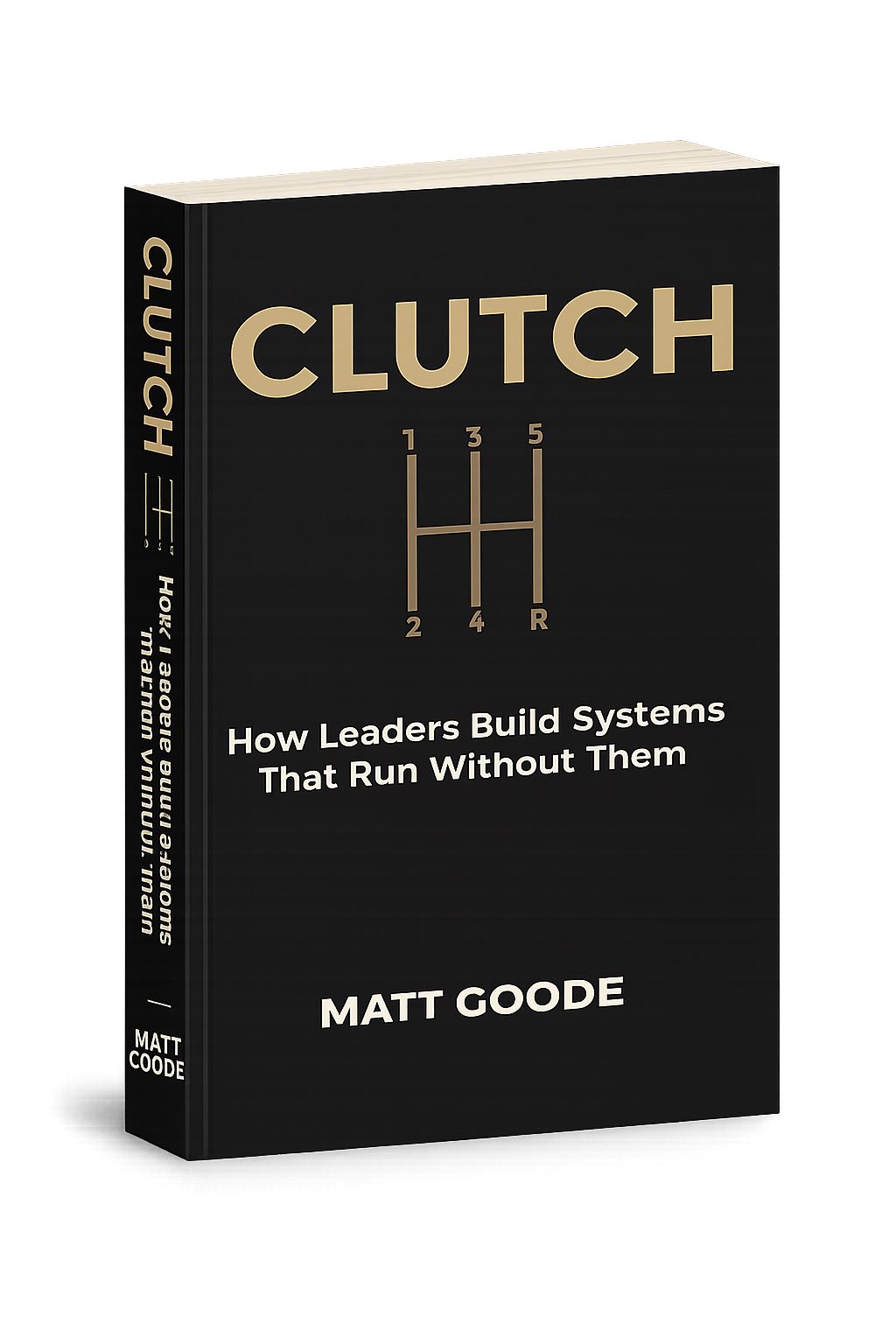
And if you read this essay and recognized your organization in it – the missing authority map, the feedback loop that still runs through [Request an ARC]
And if you read this essay and recognized your organization in it – the decisions that keep routing to you, the folder that sat untouched for three days, the team that’s learned to pause before it acts – that’s worth thirty minutes.
No pitch. Just the conversation.
Book a call – Here is my Calendly link.